
Contact us today for a free consultation! Call 888-WE-MELT-YOU or click here to email.

Fitness Blog

No-Loophole1

It’s All in Your Head - LOOPHOLES (AKA Excuses) :)

I’ve said that if I could buy a pallet of Better Than Before, Mastering the Habits of our Everyday Lives, I would give a copy to every member of the Meltdown Nation. It’s available in multiple formats at the local library, so check it out if you’ve EVER wondered why it’s so challenging to keep going in whatever new habit you’re trying to cultivate, and how to be better.


To avoid being our own worst enemies, it’s important to recognize when we’re trying to slip through loopholes of our own making. While we’ve got DOZENS of ways to rationalize and justify not doing what we know is good for us, this is an excellent breakdown of the top ten loopholes.


Check them all out, but I’m going to pick the top three that seem particular to our specific population for a brief inspection.


The Concern for Others Loophole - this was covered from the other perspective a couple of weeks ago when others may be sabotaging us, but this is when we use others as an excuse to self-sabotage. This was a HUGE challenge this past weekend when many folks were dealing with multiple graduation celebrations and felt like they had to have a token run at the buffet for politeness’ sake. It’s really OK not to have a piece of cake at each of your 5 stops ;). If someone _really_ presses, a reference to your world tour of commencement soirees not helping your waistline will probably be met with empathy rather than an insistence that you have that slice anyway, dagnabit! 😀 If you REALLY need to have something, bring your own veggie tray to share!


The “This Doesn’t Count” Loophole - it’s a special occasion (I reference Jim Gaffigan’s ode to “cake” at the office), or anything eaten in the car is imaginary (this was MY biggest pre-meltdown challenge!) or it’s a holiday (that turns into a holiweek :). Much like we often get the question whether a particular burst of movement ‘counts’ on the fitness tracker (yes if it meets the intervals.) But even if you can’t log it, of course your body knows you exerted yourself - it’s just bonus movement. Same for that unreported (insert your mini cheat here.) :)


Finally, but possibly the most popular, The Tomorrow Loophole. Today was tomorrow yesterday, so let’s cut out the middleman and just start NOW :). (I know - you’re totally re-reading that 5 times!) At 8:21 in the morning even if you had cake for breakfast, you can STILL rock the rest of the day.

Go forth and be prepared to call shenanigans on yourself anytime you hear the small voice of rationalization tempting you! :)


All the best as always,

Marcey

Coach Marcey Tidwell is started as a client with NGPT in January 2011. Joining the team as an accountability coach, she wears many hats in assisting the Meltdown Nation! Nurse Marcey by day, she brings a wealth of knowledge the program!

puppies

It’s all in your head - “Enough is as good as a feast”

“Enough is as good as a feast”

My dearest friend Barbara attributes this saying to her late Mother who was English, and I remember hearing it growing up courtesy that other maven of politesse, Mary Poppins. Simply put, there is no benefit in going overboard (on food, if taken literally, but can be applied to many areas of life.)

Boot campers are nearing their first weigh-in checkpoint, and those doing the “classic” plan are gleefully plotting their cheat days. For the uninitiated, cheat day is the first day after two weeks of following the Meltdown food plan, when newly ‘detoxed’ participants have the opportunity for one day, morning to night, to partake of whatever they want to eat (or drink.) After this weekend, 25 bootcamps-worth of Meltdowners will attest to the notion that there is little comparable to the dietary debauchery of a first cheat day. One long-time friend of the program was famed for his ‘McWenby’s’ combo - three drive-thrus, and a meal fit for a death row inmate’s final feast.

Since Little 500 also happens to fall this weekend, I will put up the most bedraggled Sunday-cheating Meltdowner with a ‘carbover’ Monday morning against the bleariest-eyed participant of Sunday Court. In many ways the effect on your body of suddenly infusing it with mass quantities of sugar and fat is the same as an alcohol hangover. It feels really good, right up until it doesn’t.

Many people find that despite having a culinary wish-list a mile long, they don’t get near the amount of food in after weigh-in that they think they will. As soon as that first meal hits the bloodstream, they hit the couch, sometimes waking up in a panic that perhaps the day has completely passed them by! NO? Phew! Time for one more run - Jiffy Treat, Chocolate Moose or Brusters? QUICK - THE SUN IS SETTING!!!!!!!

That first class the next day will be the real challenge. It’s like your legs are filled with the pureed remnants of jelly donuts. Please, for the love of all that’s good and right and pure in this world, Trish, DON’T DO THE BURPEE SINGLE SET IN T60!

Ooooh - that’s gonna hurt.

Now, I say all this NOT to be a biscuits and bonbon buzzkill. I’m merely throwing out the seed of an idea - I hope it will take root. This is NOT your last meal. You _will_ enjoy your whatever your food drug of choice is again. I’m just asking you to be mindful in your eating, even on cheat day. Especially on cheat day. Stop and enjoy the journey. Ask yourself if the next bite is because you are hungry, or because of something else. Once we are able to ascertain what it is food is doing to us and for us, then we will truly start to gain control over it. Long term, this is not the rote recitation and repetition of a proscribed food plan for eight weeks. It’s the beginning of a journey that I hope will find you healthier in the months and years to come.

Now where’s my carrot cake?

Coach Marcey Tidwell is started as a client with NGPT in January 2011. Joining the team as an accountability coach, she wears many hats in assisting the Meltdown Nation! Nurse Marcey by day, she brings a wealth of knowledge the program!

change_positive

It’s All in Your Head - Just get through the Valley of Despair!

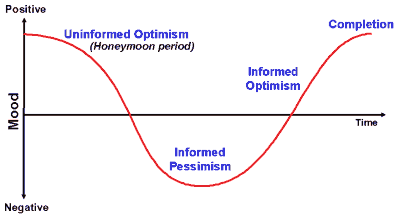
I first came across this graph in a book called The 12 Week Year - it encourages us to lay out specific plans and reassess goals periodically without having it all hinge on January 1st. Many of us start off the New Year with boundless energy and enthusiasm only to have it peter out by February. Then it seems like the year is shot, and we just revert to our well-worn habits, trudge along, and wait for another arbitrarily-assigned milestone to arrive and kick us in the pants - a birthday, a new week, month, or, hopefully not, a health crisis.

For most people new to NGPT, the boot camp experience mirrors the above pattern associated with Positive Change. At some point, you saw pictures of a friend’s before and afters online, or ran into a suddenly-svelter acquaintance in the grocery store. WOW! Where do I sign up?

Uninformed optimism - you don’t know what you’re getting into, but you want those results!

Then the emails start to come. This is going to take some work. You start to slide into ‘informed pessimism.’ You haven’t yet seen the results in YOU, and this might be harder than it looks.

Then you take your first class. And it was crazy hard but you survived! But then you woke up the next morning - when did the Mack truck drive through your bedroom and run over you?

This blog is coming out right about the time you’re hitting the trough of the graph - AKA the Valley of Despair. You’re sore and you want a Diet Coke and a piece of chocolate, dagnabit! Your spouse/children/dog may be giving you a wide berth. This is where you’re either going to jump off the slide entirely, or push through just a little more.

All we ask is to allow that first full week.

Soreness fades.

The food plan becomes easier.

The classes are less terrifying.

And then you’ll get to that first weigh in.

SQUEEEEE!!!!!

SUCCESS.

And that’s when you find yourself in “informed optimism.” This works for YOU and you’ll have seen the results.

The entire Meltdown nation has been where you are in week one.

We are here for you.

Whatever it takes to get through that first two weeks, do.

Whatever your reasons for coming through our doors, YOU are worth it.

All the best,

Marcey

Coach Marcey Tidwell is started as a client with NGPT in January 2011. Joining the team as an accountability coach, she wears many hats in assisting the Meltdown Nation! Nurse Marcey by day, she brings a wealth of knowledge the program!

future

It’s All In Your Head: Harnessing the Power of “Future You”

OK - so you know how when someone asks you to do something 3 months down the road it’s NO PROBLEM! I got this! Then a week beforehand you’re having a stroke because you don’t know WHY you agreed to do this and OMG how am I going to get this done???

Future you is an optimist that makes Chris Traeger from Parks and Rec look like Oscar the Grouch. Future you is massively motivated. Future you, when given the choice of a piece of fruit or chocolate for tomorrow’s box lunch order, will always let the better angel of your dietary nature prevail. Then when the pre-ordered lunch rolls around it’s all, “Where’s my cookie??”

Key to your success is knowing yourself. You wouldn’t leave a pot roast to cool on your counter and walk away with your labrador retriever untended in the kitchen. He eats it and it’s hard to be surprised - that’s just human (errr…dog) nature at work. Your toddler will probably not exercise any self control if her supply of Halloween candy is left for her to ingest as she sees fit.

Remember Bill and Ted’s Excellent Adventure? Ted went back in time and laid out helpful objects for himself to find later. You can be your own time traveling hero. You KNOW what you SHOULD do. Make it easier for ‘future you’ to make those decisions.

You’re at the grocery store. Shopping when you’ve just eaten means you will make better choices in the now for your near-term future. Who are we buying those cookies for? Who is going to eat them? Future us, unless that temptation doesn’t readily exist.

Scheduling your classes and weigh-ins NOW for the next two weeks or month means you’re already locked in. Don’t leave it to ‘present you’ to have the intestinal fortitude to pull yourself out of a warm comfy bed without that ten bucks hanging in the balance! (Past, present _and_ future me are all very thrifty - late cancels best involve being carried somewhere on a gurney ;).

One of my favorite things we do is collect video testimonials, often at the end of bootcamps, with people celebrating their wins. Watching these later can remind you of your enthusiasm for movement and clean eating (or at least the RESULTS you get when you are practicing those!) If you don’t have that to refer to, consider using this as a little time capsule for future you:

https://www.futureme.org/

Send an email to yourself a week, a month, six months from now.

Where do YOU want to be in those time frames?

It all starts with today.

Coach Marcey Tidwell is started as a client with NGPT in January 2011. Joining the team as an accountability coach, she wears many hats in assisting the Meltdown Nation! Nurse Marcey by day, she brings a wealth of knowledge the program!

Coach Marcey

Coach Marcey Tidwell


brain-firehead

It’s All in Your Head: I get by with a (lot) of help from my friends

As we come off Meltdown 24 and there is a rush of placements in 3P (our free online accountability program available to anyone who has completed an 8 week program) I am reminded of a great book I recently re-read: Vital Friends, the eight types being well-summarized here.

The author posits that many of us have a handful or fewer of close friends who largely influence our lives, for good or for ill. Those who influence for the good may inhabit one or more of the following categories:

  1. Builder
  2. Champion
  3. Collaborator
  4. Companion
  5. Connector
  6. Energizer
  7. Mind Opener
  8. Navigator

When I think of the people who most affected me in the beginning of this program, Cardio BIll was certainly my builder. Jen Goins as my food coach was my champion, cheering on each day. Leah Mathews excelled as a collaborator as a fellow first-time Meltdowner - we shared a lot of the same classes and were working toward similar goals. David Fletcher has been a mind-opener.

Who are the people in your life - whether in the studio or your 3P group, or at home, who are there for you in your wellness journey? In the inimitable words of Telly Savalas, “Who loves ya, baby?” Promoting those relationships is like shoring up your defenses against the Huns. Or the Honey Buns.

Who are YOU to other people? Is someone else in need of your guidance? The most common concern I hear from 3P members is what to do when someone is clearly struggling. “You’ve got this” only goes so far day after day. I suggest start with asking questions - it can be as simple as an open-ended, “Can you tell me about that?” You may be surprised what comes out.

Need a Vital Friend? Reach out! The Meltdown Nation stands ready.

Coaches Corner: Food Isn’t Just Food by Coach Marcey

I was 5 years old when we lived in Florida - a pecan tree graced the front yard of our naval base housing, and a pair of squirrels would chase each other up and down the tree, hiding nuts from each other. It was way better entertainment than TV. Mom would go out front and pick some off the ground, and we’d patiently work our way through them, Mom cracking them open with a hammer, and the kids working them out of the shells.

Anyone who thinks food is JUST food was never a child.

Grandma’s fried mush sampled only on rare trips home to PA when we traveled with Dad during his service career. Baloney sandwiches on Wonder bread to keep three growing children quiet in the car during the interminable ride back from the commissary. Arteries forgive me - SCRAPPLE consumed on the weekend while little brains ingested the Creature Double Feature.

Evolutionarily speaking, to survive ya gotta eat, so it stands to reason that taste is probably the most developed sense, but in fact it’s the least in terms of brain wattage devoted to it (vision, hearing, touch and smell _all_ trump it in that order.) So WHY are we obsessed with food?

The hippocampus is the part of the brain primarily tasked with memory, and connecting senses with emotions, AND has receptors for hormones associated with appetite. It also connects the brain and the gut in ways we’re only just beginning to understand, but anyone who has ever had a bout of food poisoning or similar negative association with a taste knows all too well how the mere thought of that item can send the belly into anticipatory revolt.

And despite our rapidly evolving culture, our brains and bodies are pretty slow to catch on that MOST of us don’t need to pack on weight to get us through the long hard winter. We don’t have to worry about times of famine. But skipping breakfast is enough to trigger your body to slow down the metabolism just in case the next meal isn’t forthcoming.

It is ALWAYS my hope that the cerebral brain trumps the reptile brain; that our higher thought processes drown out the deeply-buried childhood associations we may no longer even be cognizant of. Being aware of the efficiency of our body in storing calories for “later” lets us know we’ve got enough to fight against with biology without letting also 35 year old ad jingles sabotage our success now.

Coach Marcey Tidwell is started as a client with NGPT in January 2011. Joining the team as an accountability coach, she wears many hats in assisting the Meltdown Nation! Nurse Marcey by day, she brings a wealth of knowledge the program!

Coach Marcey

Coach Marcey Tidwell

Coaches Corner: Weird Al Speaks Truth with Coach Marcey

To quote the great songwriter from his first album, “I’ll be mellow when I’m dead.” - (There is actual footage somewhere of me lip syncing one of his tunes, circa 1988, in a high school variety show…)

So I’ve kinda lived by this sentiment forever. And this is going to seem to some “do as I say, not as I do.” BUT I hope you will help to keep me accountable going forward to this one thing that is holding back my results, and may well be holding back yours.

Recovery.

Heyheyhey - I saw you roll.your.eyes. :)

Stick with me here!

Time and time again, Meltdowners will come to me seeming to be doing all the right things - food is on point, exercising with good effort, and yet the scale won’t budge.

I’m surprised at how often my day job and the issues most common in the Meltdown intersect - here’s a knowledge bomb on stress that I give to my students: it’s not the load you carry, it’s how long you carry it. Yes, I know you have had years of (insert your crazy life challenges here - job, other job, kids, school, parents, spouse, ex-spouse, money trouble, insane boss or co-workers, the to-do list that won’t end, and insufficient or poor quality sleep) and handled it just fine. We can all take a variable amount of abuse on our psyche and body and compensate - sometimes for a really long time depending on how stubborn you are! But you ARE accumulating the evidence of that stress somewhere in you. And it is causing changes in how your body responds to your efforts to burn fat.

This weekend, hubby and I went for a “couple’s massage” - the “Deep Rub” consists of the extraordinarily talented therapist going after trigger points (by my request) with a gusto that should mandate a safe word. I was a pile of lumps and knots just below the surface reminiscent of bubble wrap and about as crackly.

It’s been around two years since we added recovery minutes into a required portion of the fitness trackers at NGPT. Body shop and Yoga classes have traditionally been the red-headed stepchild of the Meltdown experience. If you don’t come out sopping in sweat and ready to die, is a class really worth it?

YES. Take advantage of those options. I am Nancy Adams’ #1 Body Shop groupie. But that’s not the only way to get recovery.

Foam rolling - check out those free videos on the wemeltyou youtube page - click here.

Stretching. Massage. Lacrosse ball.

SLEEEEEEEP.

Sleep deserves its own whole separate blog, which will follow, but in the meantime, WHAT are you doing to counter the effects of the hard-charging life you lead? You may say you don’t have time for recovery - I say confidently and from personal experience that you are wasting all those other hours if you’re NOT working on that actively. Email me! [email protected]

Coach Marcey Tidwell is started as a client with NGPT in January 2011. Joining the team as an accountability coach, she wears many hats in assisting the Meltdown Nation! Nurse Marcey by day, she brings a wealth of knowledge the program!
Coach Marcey

Coach Marcey Tidwell


images-3

Coaches Corner: The Goldilocks Theorem with Coach Marcey

We’re speeding through the second half of the January bootcamp as I write this. The beginning of the year has a special arbitrary motivational magic, so the results are generally especially impressive. But in the way of all or nothing thinking that is human nature, sometimes participants are incredibly focused on that “finish line.” I GET TO GO BACK TO NORMAL!!!! You may even have family and friends who are counting the days until graduation.

Not so fast there.

Normal is what brought you to NGPT.

Normal is common. Ordinary. Conventional.

I suspect very few of us grew up hoping to live a common life.

A certain percentage of people participating in the program will finish viewing it as a one-off. They go HARD for eight weeks and then stop. Been there, got the cool Tshirt, now where’s my real bread?

OR, some may go on the other end, continue to push to the extreme, eventually burning out.

Our dance teacher Matt says that when we are trying to learn a new move, we’ll generally over-do motions, then under-do, before settling into that “just right” Goldilocks middle ground.

Start to consider what your “just right” mindset looks like. Encourage yourself to give it your all during this launch period, but also save room for the idea that life is not meant to be a series of bootcamps with months of hedonistic abandon linking them. It may take more than one to cement the lifestyle, but know that the goal of your coaches is to give you the information to make good choices that fit into your life outside the bootcamp confines. The Meltdown system is set up to provide you with ongoing checkpoints to determine whether your “just right” might be a little “too much” or “too little” to maintain results.

“The rest of your life” is too scary a thought to contemplate on any topic. AA only asks you to take it one day at a time. I’m going to ask you this: make one small step towards committing to your post-bootcamp life. Go now and sign up for your week 10 weigh-in. (That’s March 20th or 22ndish - the weekend closing out spring break here in beautiful Bloomington.) Maybe you’ll be vacationing that week, but tell yourself NOW that that critical checkpoint will not pass without you honoring your eight weeks of hard work by holding yourself accountable for “what’s next.”

And when you do this? Drop me an email at [email protected] and tell me, and the one thing you’re currently celebrating so far in your progress.

AND? If you’ve fallen off the wagon from a prior Meltdown adventure, take that FIRST step toward regaining control - weigh-in this weekend (it’s not a bootcamper checkpoint!) and email me. We miss you. You’re always a member of the Meltdown family no matter where you’ve traveled since we last saw you :).

Coach Marcey

Coach Marcey Tidwell

Coach Marcey Tidwell is started as a client with NGPT in January 2011. Joining the team as an accountability coach, she wears many hats in assisting the Meltdown Nation! Nurse Marcey by day, she brings a wealth of knowledge the program!

 

Why Train with a Heart Rate Monitor?

by Brian Gilley

Heart rate monitors are one of the best tools to assess your fitness and systematically improve performance. A heart rate monitor measures your heart rate in real time and allows you to use the information it gathers to adjust your performance and effort and set specific exercise goals. Using a heart rate monitor to track your effort and ability is an excellent way to understand how efficiently you are working.

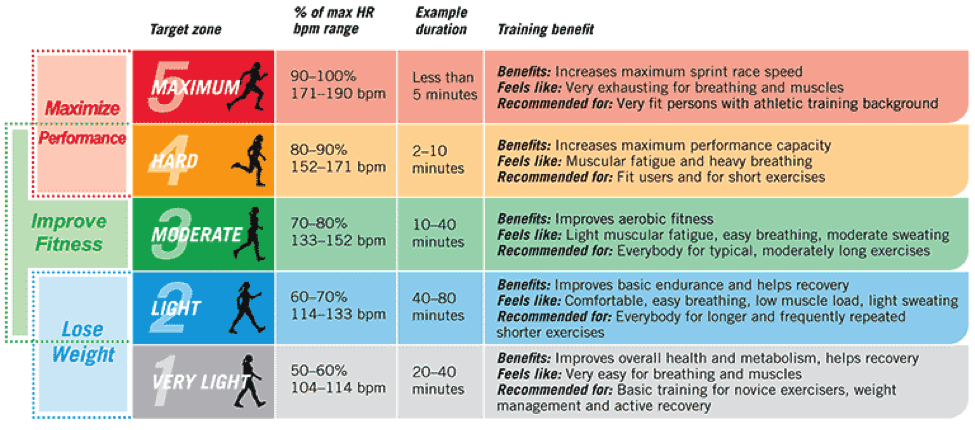
One thing many fitness instructors and trainers notice in interval training (a fundamental method of NGPT) are two extremes of the effort spectrum. On one end are individuals who are new to cardio exercise. This group often has trouble assessing their own effort because all exercise is difficult for people who have not been active all of their lives or are coming back to exercise after long periods of being sedentary. These individuals often exercise at a ‘base heart rate’ that is too low (light or very light on the chart below) because their perceived level of difficulty correlates to a heart rate that is too low for significant fitness improvement and maximizing calorie burn. (What I call base heart rate is the minimal working heart rate or the base level of perceived exertion that an individual returns to for the “off” periods of intervals or uses for their steady state exercise.) These individuals’ perceived effort places their maximum effort for intervals at the mid to top end of the ‘moderate’ zone of exertion (see the chart below), which is too low to obtain the full benefits of interval training. Additionally, the moderate to hard zone is where individuals should be during their steady state cardio. Having an effort- base in the light to very light zone and using the moderate zone as the top-end of one’s exertion will not produce the same benefits as will having a base in the moderate zone and moving into the hard or maximum zone of effort. Knowing the correct base heart rate for cardio based on individual characteristics (age, weight, sex, and height) will help a person find their optimal effort heart rate zones and increase fitness more quickly while ensuring they are getting the full benefit of cardio. As a person becomes more fit these numbers will shift to reflect improvements. A heart rate monitor allows this group to exercise within their proper heart rate and increase the benefit of interval training and insures that steady state exercise is within an adequately strenuous zone.

This is a general informational chart for reference. Specific Zones will be person-specific.

heartrate chart

Chart Credit: R. McCall’s Adapted Physical Education Site

On the other end of the spectrum are people who are fairly fit and who are also unaware of their base level of exertion and thus often have their base level of effort in the ‘light’ or lower end of the moderate zone (see the chart above for categories). When doing cardio with bursts of energy, such as HICs and tabatas, this group has the ability to reach the ‘maximum’ zone within the work period of an interval, but cannot because they begin the interval at the very light zone. These bursts, however, should originate from the moderate to hard zone rather than from the light zone because the interval time is not long enough for them to reach their maximum (anaerobic) level from the light level before the time is up. Thus, the work period is spent trying to move across too many heart rate zones instead of being able to move directly to the maximum zone. Intervals should begin from a zone that is already strenuous. For example, within a typical set of HICs using 40 seconds off and 20 seconds on, the ‘off’ period should be at the moderate/hard level and the ‘work’ period should increase to the maximum (from the top end of aerobic level into the anaerobic). Thus, the “off” periods are not rests, but rather they are within the aerobic zone where there is significant effort and there are improvements being made in capacity. Knowing one’s heart rate zones and using a monitor during exercise insures that workouts provide optimal results and ability development. The research literature in exercise physiology tells us that moving into the work period of an interval from a heart rate just below one’s maximum zones exponentially increases the benefit of intervals.

A heart rate monitor allows you to know the range of your base level of exertion and take full advantage of your hard and maximum efforts. Simply knowing average heart rates for your performance, and assessing your own levels of exertion from very light to maximum allows you to get the most out of exercise – particularly intervals. As you become more knowledgeable of your own capacity, you can use the information from a heart rate monitor to set goals for increasing performance and track improvement over time. There are also multiple tests that can be done with heart monitors, such as aerobic threshold or lactate threshold, that provide more detailed information for fine tuning training plans for specific goals. There are numerous reliable resources on the internet with heart zone charts, sample workouts and advice on tracking your improvements.

What kind of Heart Rate Monitor Should I Buy?

There are too many variations on heart rate monitors to mention here, but two types that I’ll highlight. There are heart rate monitors with watches that collect information by linking with a chest strap, and there monitors that only have watches and use an individual’s pulse on their wrist to collect information. Most athletes prefer chest strap models because they are more accurate and are less prone to disruptions in transmission. Most chest strap models also work with spin bikes and smart phones. I recommend buying an ANT+ enabled monitor because they will connect with most recently manufactured cardio equipment. Bluetooth enabled monitors are also becoming widely available and allow you to track data on your smartphone. There are a dizzying number of features available on heart rate monitors. For beginners and people who primarily exercise indoors a simple easy-to-read monitor with the ability to obtain average heart rate and calories is sufficient. People who exercise outdoors, such as runners and cyclists, may want a heart rate monitor with GPS as it will correlate pace, distance and elevation with heart rate and provide a more accurate portrait of the effort expended during any given period of exercise. Monitors specially designed for runners come with foot pods and monitors for cycling can measure cadence and watts produced. Many monitors also have software or apps for creating training plans, measuring long-term results and comparing yourself to other athletes throughout the world using the same device.

Using a heart rate monitor during exercise will add a performance aspect to your training and, when used properly, can accelerate your improvement more quickly than using perceived exertion to guide your efforts.

Brian Gilley is a lifetime cyclist, beginning with banana seats and BMX as a kid. He was a sponsored mountain bike racer in college and has raced competitively on the road in the US and Europe. Brian has worked with collegiate cycling programs for over a decade and has advised US national champions in road and cyclocross. Currently he is coaching the Three Parks Hooligans (3PH) Little 500 team at Indiana University. He is a professor of anthropology at IUB and the Director of IU’s First Nations Educational and Cultural Center. Brian and his wife Caroline joined NGPT as a clients and quickly became regulars in our SPIN program, we are happy to have Brian on the instructor bike on Saturday mornings!

Doctor’s Advice: Your Guide on Sickness and Working Out

by David Fletcher MD

Tis the season…for respiratory infections!

It’s the most wonderful time of the year to get a cold, bronchitis and the flu. This begs the question, “Should I exercise on through this plague or take time to recover so I can live to fight another day?”

Here are a few things for you to consider when making that decision.

Above or below the shoulders.

Respiratory infections that cause symptoms primarily above the shoulders – runny or stuffy nose, ear ache, or mild sore throat are often treated either by waiting them out or taking some form of over the counter symptomatic treatment. Nothing really makes them go away faster but rather only helps reduce the symptoms. Often with these “colds”, it is possible to continue some degree of physical activity as you feel able. Start with a short walk and move up in time and intensity as tolerated.

Respiratory infections, like influenza and bronchitis, that cause symptoms primarily below the shoulders or whole body symptoms – fever, shortness of breath, muscle pain, cough – should prevent you from exercising until they have subsided.

Can I do the work out?

Consider this as well. You should ask yourself what is that value and purpose of exercising through an illness? Can I perform the work intended? Am I just trying to burn calories? Am I inclined to run today because it’s listed right there in my training plan? In general, if you can’t do the work you need to do then don’t do it. It is better to take the time your body needs to recover. Rest now and save it for another day when you can work maximally.

Try not to take out everyone around you!

It’s hard to imagine but that person doing a burpee right next to you might not care as much about your training plan as you do, so coughing all over them and the equipment might earn you the stink eye at best. Please take into account when using your best judgment. Wash your hands frequently, cover your mouth, wipe down your equipment. Common courtesy should prevail here. And here’s a secret. No one can tell with certainty when they are no longer contagious, so that line, usually said in between coughs, isn’t terribly reassuring.

How long should I wait?

Truth is that there many different causes of respiratory infections so it’s difficult to offer a broad sweeping generalization. Some we can test for (influenza) and most we group into on big similar category. A majority of the seasonal viral infections that come and go on their own will last between 7-14 days. Some respond to specific prescription treatment and most come and go regardless of what you do. Again I would refer the idea that if you can not do the work as intended it is best to give yourself additional time for recovery. If you’re feeling better 24-48 hrs after your fever dissipates, you can see how it goes. Start by reducing the time and intensity of your effort and increase as you see fit.

Respiratory infections, Medications, and Exercising.

I would discourage most athletes to stop exercise if you are taking medications that require a prescription. Hopefully their use has been reserved for a degree of illness that is more significant and therefore commands the necessary degree of rest.

In addition, there are many medications that can have an adverse effect on your body when it is in a compromised state of illness. While ibuprofen will help with your aches, pains, and fever symptomatically, it may have a negative affect on your kidneys during exercise, especially if you are dehydrated by a lack of intake and an excess of mucus coming from, well, everywhere! Pseudoephedrine and many decongestants/antihistamines can aggravate the cardiac rhythm. Throw on top of that a hard set of mountain climbers and your stuffy nose might not seem such a big deal after all.

The bottom line is to give your recovery as much consideration as you do your workout. Consider the scope of your symptoms, whether you will benefit from the effort or not, and how many folks you may expose along the way.


David Fletcher MD is owner of Fletcher Sport and Family Health (FSFH). He is a primary care physician whose private practice is focused on medical care of athletes and general care of adults. His practice is located in Bloomington, IN.

David has been practicing primary care medicine since 1991. During that time he has worked in physical and rehabilitation medicine, work-related injuries, student health, and underserved rural health care. More recently he opened FSFH to provide detail oriented medical care and training supervision for athletes of all levels. His broad experience with adjunctive medical practitioners and treatment options makes his approach to wellness uniquely holistic.

David is currently accepting new clients on a limited basis. Please submit all inquiries to [email protected] or you can visit www.davidfletchermd.com