by Brian Gilley
Heart rate monitors are one of the best tools to assess your fitness and systematically improve performance. A heart rate monitor measures your heart rate in real time and allows you to use the information it gathers to adjust your performance and effort and set specific exercise goals. Using a heart rate monitor to track your effort and ability is an excellent way to understand how efficiently you are working.
One thing many fitness instructors and trainers notice in interval training (a fundamental method of NGPT) are two extremes of the effort spectrum. On one end are individuals who are new to cardio exercise. This group often has trouble assessing their own effort because all exercise is difficult for people who have not been active all of their lives or are coming back to exercise after long periods of being sedentary. These individuals often exercise at a ‘base heart rate’ that is too low (light or very light on the chart below) because their perceived level of difficulty correlates to a heart rate that is too low for significant fitness improvement and maximizing calorie burn. (What I call base heart rate is the minimal working heart rate or the base level of perceived exertion that an individual returns to for the “off” periods of intervals or uses for their steady state exercise.) These individuals’ perceived effort places their maximum effort for intervals at the mid to top end of the ‘moderate’ zone of exertion (see the chart below), which is too low to obtain the full benefits of interval training. Additionally, the moderate to hard zone is where individuals should be during their steady state cardio. Having an effort- base in the light to very light zone and using the moderate zone as the top-end of one’s exertion will not produce the same benefits as will having a base in the moderate zone and moving into the hard or maximum zone of effort. Knowing the correct base heart rate for cardio based on individual characteristics (age, weight, sex, and height) will help a person find their optimal effort heart rate zones and increase fitness more quickly while ensuring they are getting the full benefit of cardio. As a person becomes more fit these numbers will shift to reflect improvements. A heart rate monitor allows this group to exercise within their proper heart rate and increase the benefit of interval training and insures that steady state exercise is within an adequately strenuous zone.
This is a general informational chart for reference. Specific Zones will be person-specific.
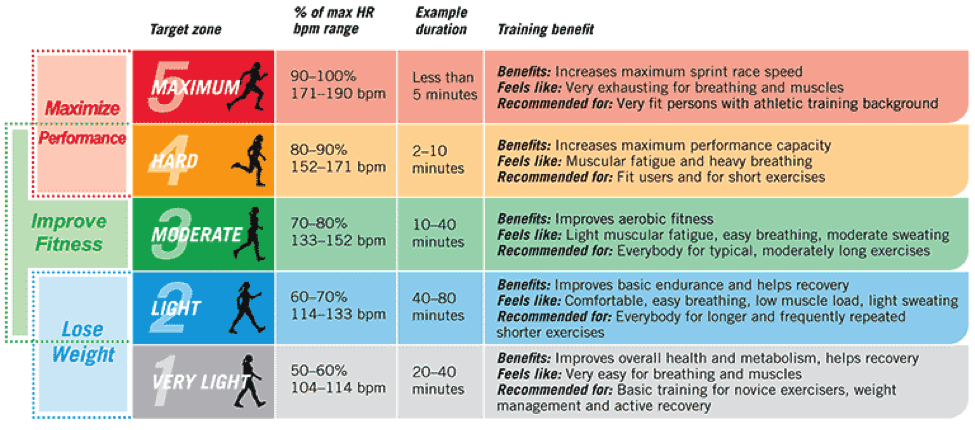
Chart Credit: R. McCall’s Adapted Physical Education Site
On the other end of the spectrum are people who are fairly fit and who are also unaware of their base level of exertion and thus often have their base level of effort in the ‘light’ or lower end of the moderate zone (see the chart above for categories). When doing cardio with bursts of energy, such as HICs and tabatas, this group has the ability to reach the ‘maximum’ zone within the work period of an interval, but cannot because they begin the interval at the very light zone. These bursts, however, should originate from the moderate to hard zone rather than from the light zone because the interval time is not long enough for them to reach their maximum (anaerobic) level from the light level before the time is up. Thus, the work period is spent trying to move across too many heart rate zones instead of being able to move directly to the maximum zone. Intervals should begin from a zone that is already strenuous. For example, within a typical set of HICs using 40 seconds off and 20 seconds on, the ‘off’ period should be at the moderate/hard level and the ‘work’ period should increase to the maximum (from the top end of aerobic level into the anaerobic). Thus, the “off” periods are not rests, but rather they are within the aerobic zone where there is significant effort and there are improvements being made in capacity. Knowing one’s heart rate zones and using a monitor during exercise insures that workouts provide optimal results and ability development. The research literature in exercise physiology tells us that moving into the work period of an interval from a heart rate just below one’s maximum zones exponentially increases the benefit of intervals.
A heart rate monitor allows you to know the range of your base level of exertion and take full advantage of your hard and maximum efforts. Simply knowing average heart rates for your performance, and assessing your own levels of exertion from very light to maximum allows you to get the most out of exercise – particularly intervals. As you become more knowledgeable of your own capacity, you can use the information from a heart rate monitor to set goals for increasing performance and track improvement over time. There are also multiple tests that can be done with heart monitors, such as aerobic threshold or lactate threshold, that provide more detailed information for fine tuning training plans for specific goals. There are numerous reliable resources on the internet with heart zone charts, sample workouts and advice on tracking your improvements.
What kind of Heart Rate Monitor Should I Buy?
There are too many variations on heart rate monitors to mention here, but two types that I’ll highlight. There are heart rate monitors with watches that collect information by linking with a chest strap, and there monitors that only have watches and use an individual’s pulse on their wrist to collect information. Most athletes prefer chest strap models because they are more accurate and are less prone to disruptions in transmission. Most chest strap models also work with spin bikes and smart phones. I recommend buying an ANT+ enabled monitor because they will connect with most recently manufactured cardio equipment. Bluetooth enabled monitors are also becoming widely available and allow you to track data on your smartphone. There are a dizzying number of features available on heart rate monitors. For beginners and people who primarily exercise indoors a simple easy-to-read monitor with the ability to obtain average heart rate and calories is sufficient. People who exercise outdoors, such as runners and cyclists, may want a heart rate monitor with GPS as it will correlate pace, distance and elevation with heart rate and provide a more accurate portrait of the effort expended during any given period of exercise. Monitors specially designed for runners come with foot pods and monitors for cycling can measure cadence and watts produced. Many monitors also have software or apps for creating training plans, measuring long-term results and comparing yourself to other athletes throughout the world using the same device.
Using a heart rate monitor during exercise will add a performance aspect to your training and, when used properly, can accelerate your improvement more quickly than using perceived exertion to guide your efforts.
Brian Gilley is a lifetime cyclist, beginning with banana seats and BMX as a kid. He was a sponsored mountain bike racer in college and has raced competitively on the road in the US and Europe. Brian has worked with collegiate cycling programs for over a decade and has advised US national champions in road and cyclocross. Currently he is coaching the Three Parks Hooligans (3PH) Little 500 team at Indiana University. He is a professor of anthropology at IUB and the Director of IU’s First Nations Educational and Cultural Center. Brian and his wife Caroline joined NGPT as a clients and quickly became regulars in our SPIN program, we are happy to have Brian on the instructor bike on Saturday mornings!